Author Archives: wallywalou

Unknown's avatar

About wallywalou

We are Dave Summerfeldt and Sally Rothwell and we live aboard a 2004 Outremer 45, Wally Walou.

Outremer Cup

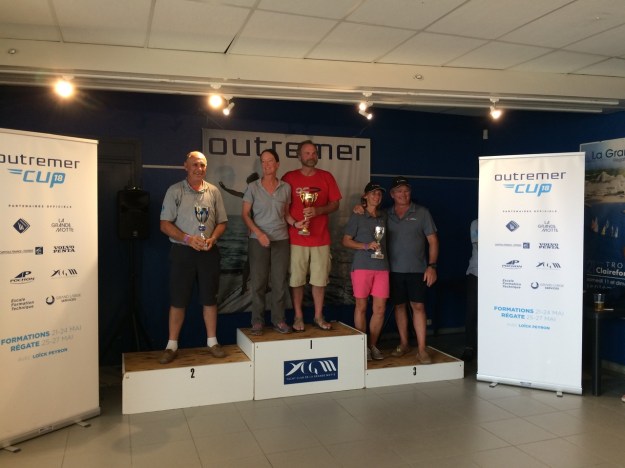
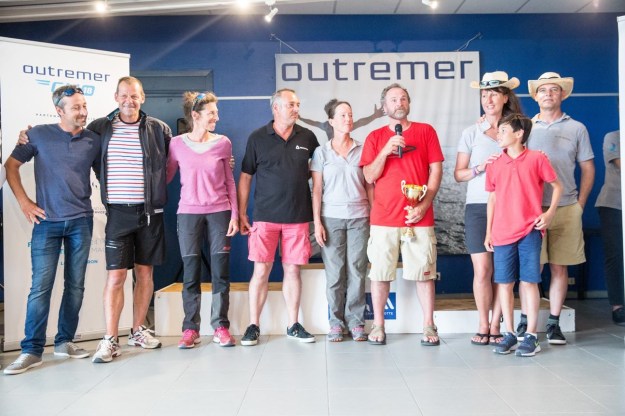
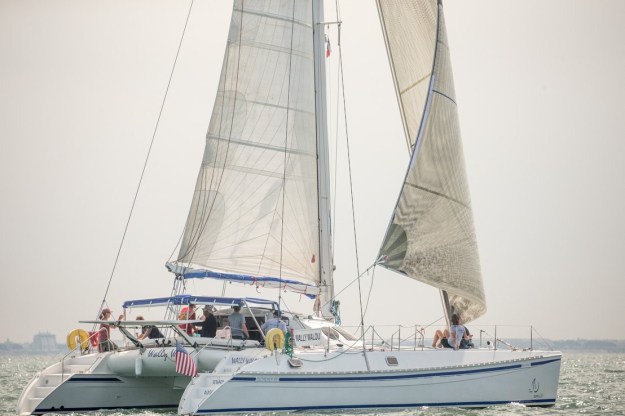
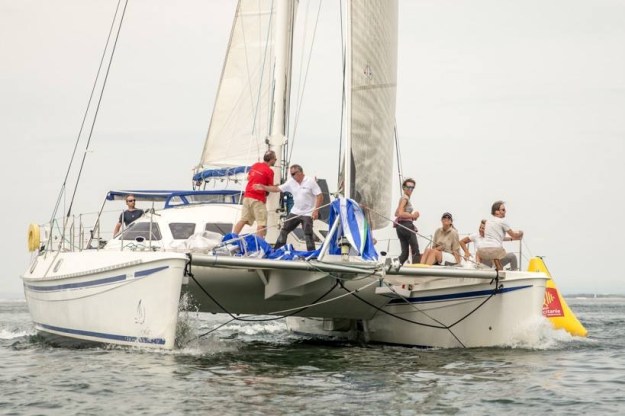
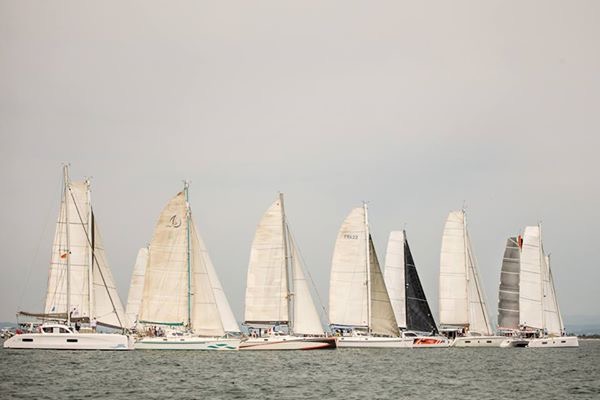
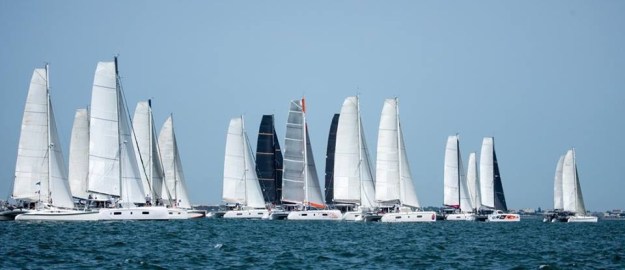
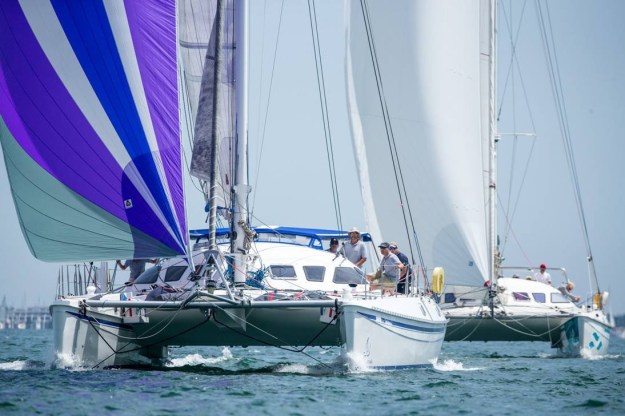
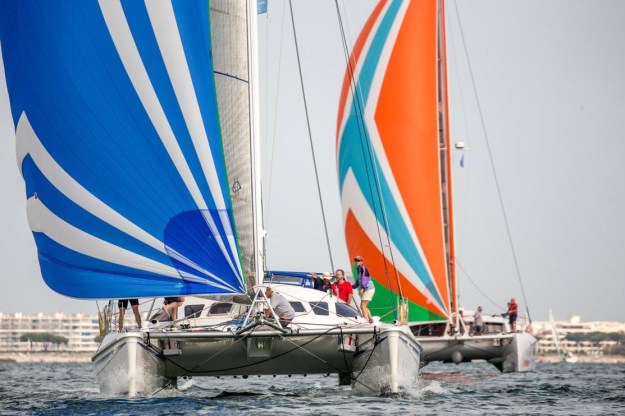
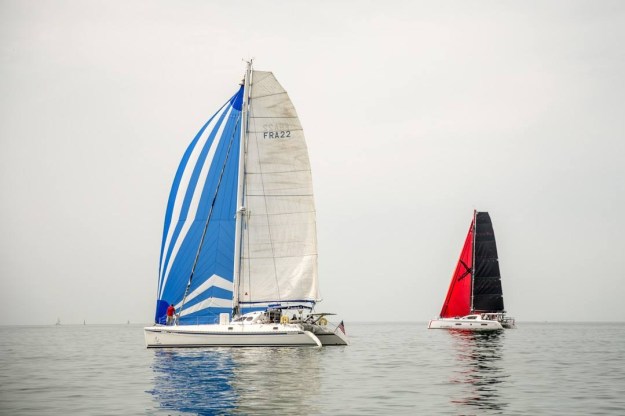
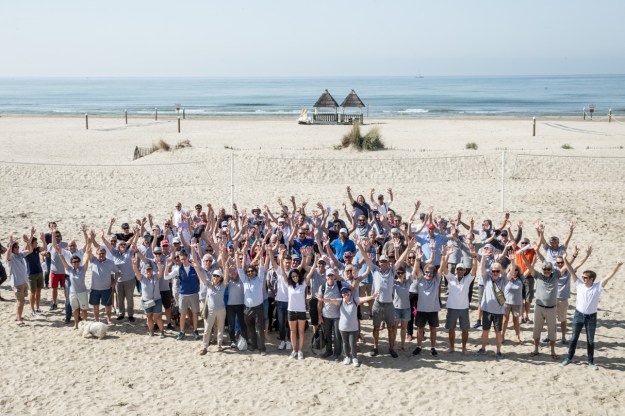
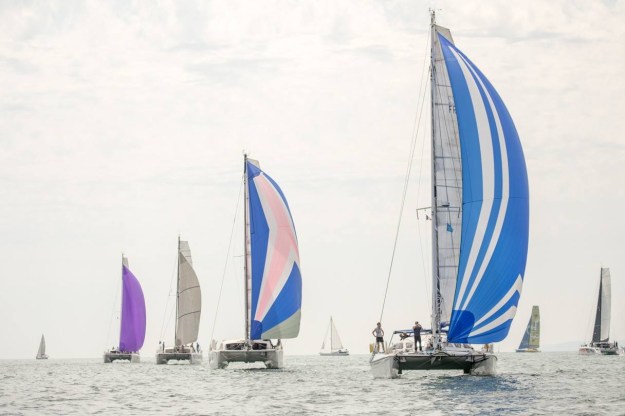
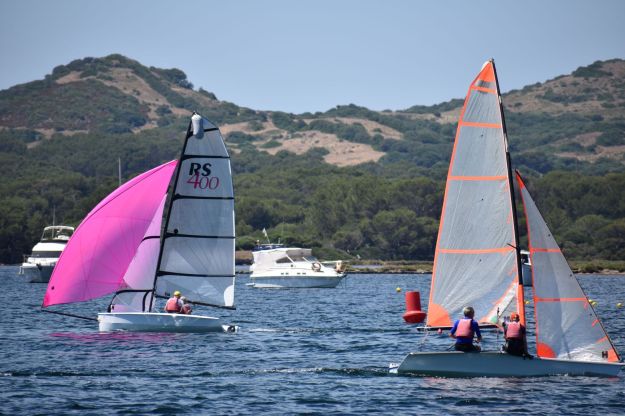
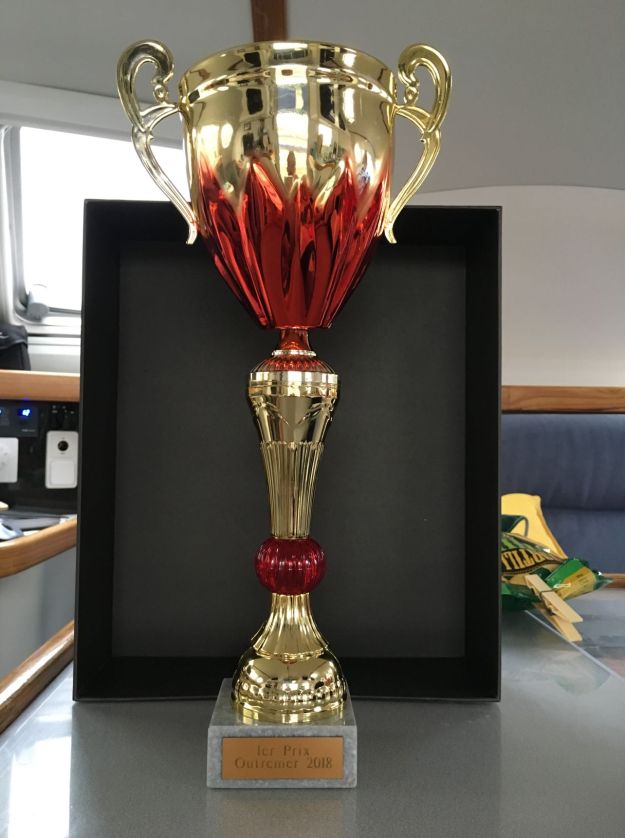
The Outremer Cup (Outremer is the manufacturer of our boat, Wally Walou) is Outremer’s annual “company picnic” with 20+ catamarans competing in 3 days of races, plus training classes and social events.  We had a very good outcome at this year’s Outremer Cup races: we won!

Trophy.small

Podium1.small

Podium2.small

We Won.small

Waving.small

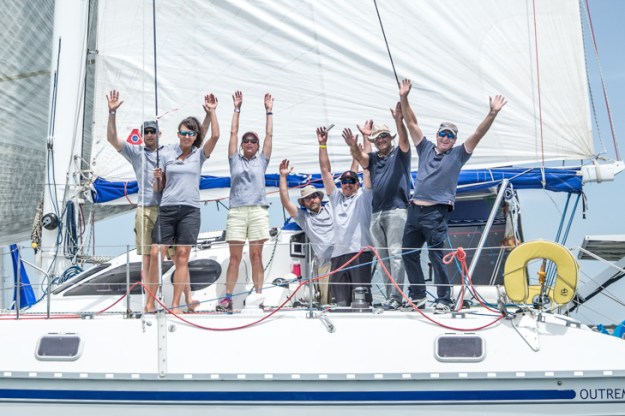
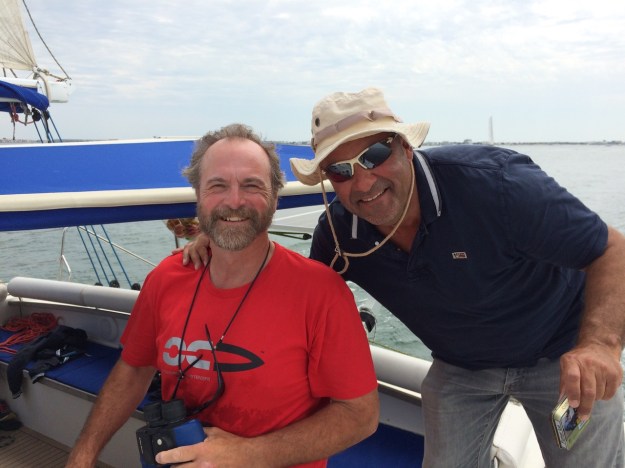
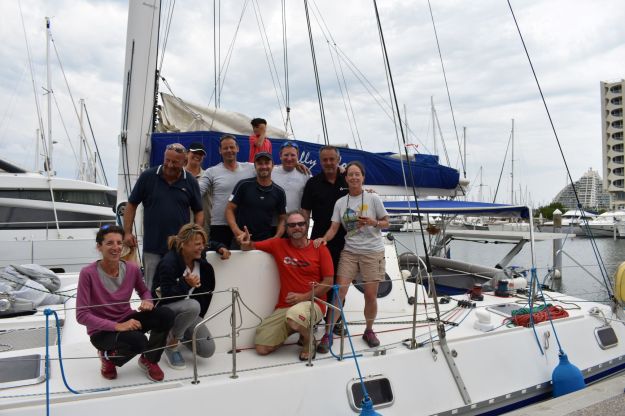
We have been in friendly contact with the two French sailors that originally commissioned Wally Walou, Laurent and Gerome, and we were lucky enough to get them both to come race with us this year. We also had our sailmaker, Alain, from Delta Voiles aboard and an American couple, Matt and Tricia, that own an Outremer 42 from Seattle, so we had a good experienced French contingent to support us less experienced but enthusiastic Americans!

Dave_Laurent.small

Crew.small

Our goal was to continue the legend of Wally Walou, which had won the Outremer Cup numerous times before. To accomplish that goal it was important to make Wally as lightweight as possible; so, our American guests agreed to take our SUPs to their B&B, and we left our dinghy at our slip with our primary anchor and all of our primary chain and rode. Also our passerelle (gangplank) and the few “heavy” fenders that Laurent identified (he did approve of our lightweight fendertex fenders:-). We also unloaded the 50 lb sewing machine and some of Dave’s tools into a crew member’s car. So we were taking the race reasonably seriously. There were 26 Outremers racing, from the smallest O38/40 to the largest the O5X (60ft).  Here is Dave’s summary of the 3 days of races…

Day 1 – I had 2 of my French crew attend the skippers’ meeting with me and we still managed to almost miss the existence of the first day’s regatta. They had a “timed run” again this year and we were thinking that this was all we were doing. So after the run we went out in the bay and Laurent and I went swimming to scrub the last infinitesimal layer of slime off both hulls and rudders to improve our light air performance. This is what you get when you invite crazy racers aboard your boat:-). I think we had wine and lunch out when we heard the 10-minute warning announced over the radio and we were all shouting “What race?!!!” We got our act together and with Laurent’s guidance got a very decent start and started to pull away from the fleet. Wind was very light, 4-8 knots max for most to the first race, and only the first 5 boats made it around the first windward mark before the wind died. So Wally Walou and four others kept going and the rest of the fleet sat there drifting waiting for the wind to come back and watching us go! We managed to stay in the lead until partway up the second windward leg and Crazy Flavour had slightly better wind and managed to pass us. As we approached the windward mark for our second rounding the rest of the fleet was starting to move again so things got interesting as we ducked and dodged our way through. In the end we were third behind Crazy Flavour (Carbon 49 or 51) and Excalibur, a brand new 5X.

Genoa.small

CodeD.small

At The Mark.small

Together.small

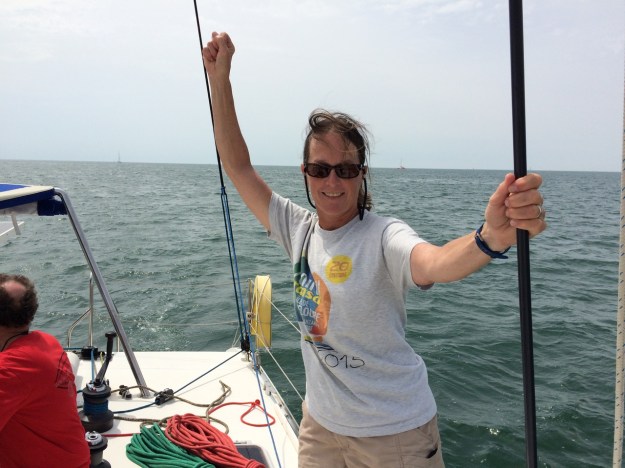
Day 2 was again very light wind, so light that initially they called a pause and the whole fleet motored over east of Port Camargue and everyone went swimming. The wind came up a bit and we got two races in with a few fleet recalls since 25% of the boats were over the start line early. We got good starts and made very few mistakes taking 1st in both races. The carbon 51s, Crazy Flavour and Vitamine, and the Aussie 5X Excaliber were always close and a threat.

In The Lead.small

Sail Change.small

With Laia.small

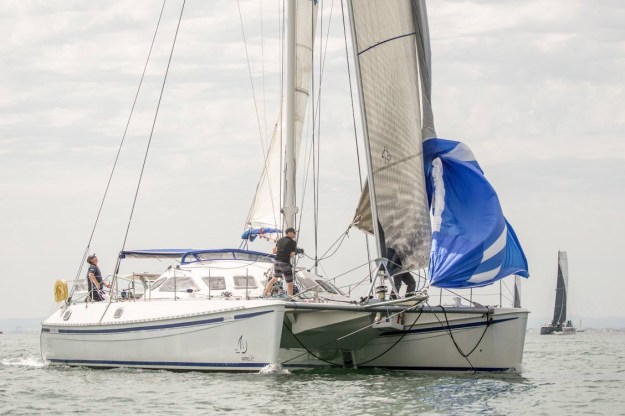
Day 3 was more light wind. We had 11 crew aboard, 9 of them French!  1 race planned and started on time. With Laurent’s expert advice we again got a good start position. This race had the whole fleet parked for a while waiting for wind. We were in good position when the wind died, we were sort of ahead with Crazy Flavour, Vitamine and Ritual leeward of us and slightly behind and Excalibur to windward but slightly back as we drifted.  We had been on a downwind run when the wind died.  As we waited we noticed some monohulls sailing down toward our position flying Spinnakers. We quickly dropped our chute and unfurled our Genoa since the new wind was going to be forward of our beam. Excalibur got the wind first but we were able to make the mark ahead of them and barely managed to hold off Vitamine for a final 1st place!

With Vitamine.small

With Excalibur.small

GroupShot.small

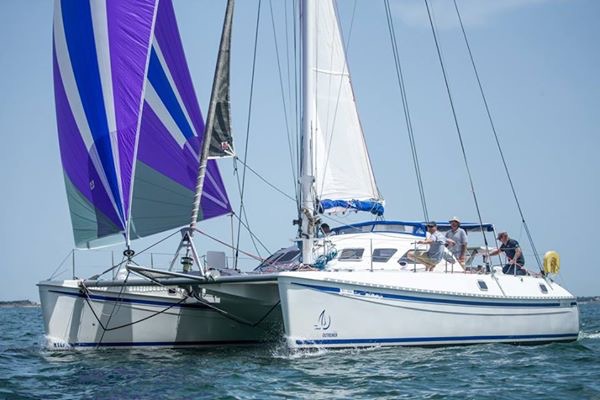
Wally Walou is one of 2 Danson 45s with a lighter hull layup (same layup they used for the 55 light series) and the only Danson 45 with a carbon rotating mast.  Our lightship weight (delivered?) is 6100 kg and our Max is 8500kg. We have been making modifications to Wally over the last 18 months, most of which have added weight and decreased performance. I’ve been worried that we may have messed up Wally Walou…we are now over that worry:-).

Laurent was of the opinion (and I agree) that we had the perfect conditions for Wally Walou. If the wind had been 15 kts or more the 51s and 5Xs would have been fully on their feet and caused us much more grief. We had a very good crew on a well prepared, light Outremer, and we made very few mistakes.

Group.small

Spain and Menorca

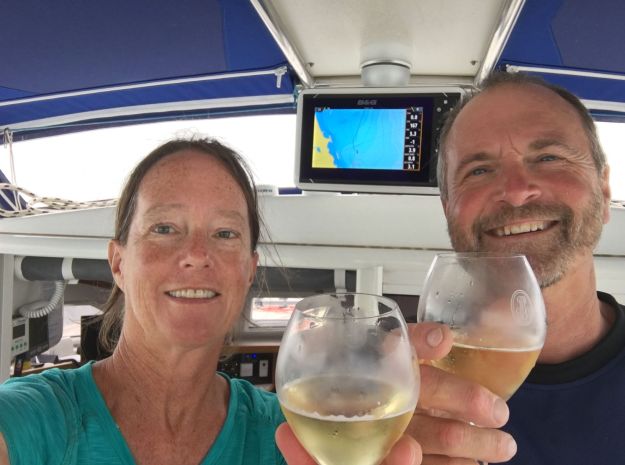
On June 3, 2018 we left Port Camargue, France and headed west toward Spain. So happy to have most of the major boat projects done and to be cruising again!  With plans to be back in Alaska by early July we had a month to spend exploring, so we celebrated our first night anchored out near Cap d’Agde with a champagne toast from the bottle we won at the Outremer Cup (see Outremer Cup blog).

champagne.small

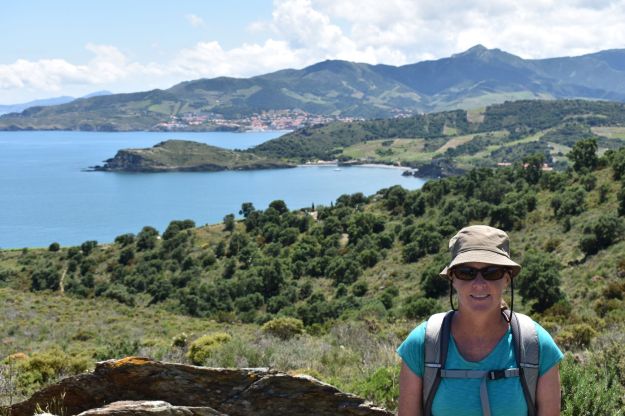
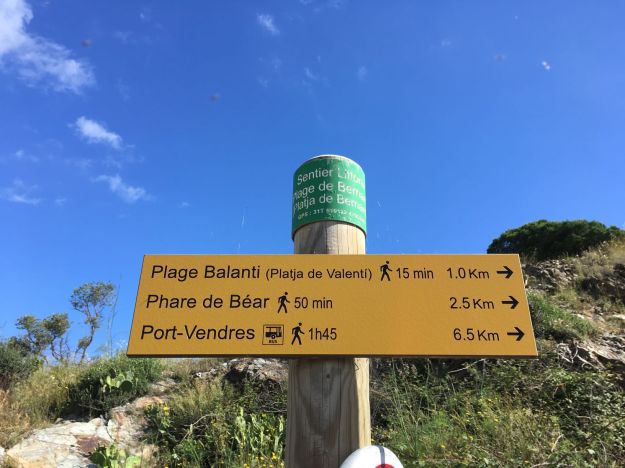
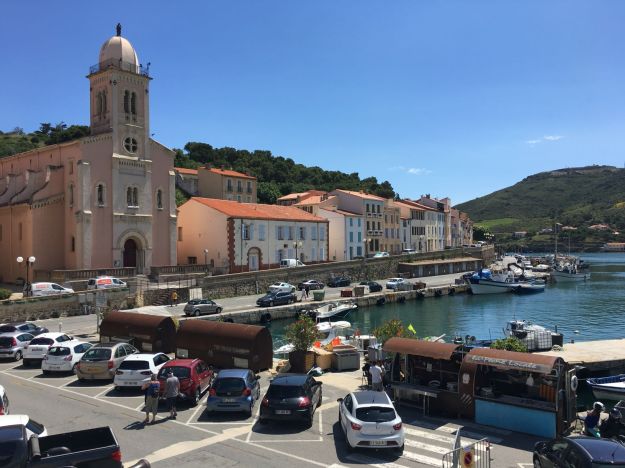
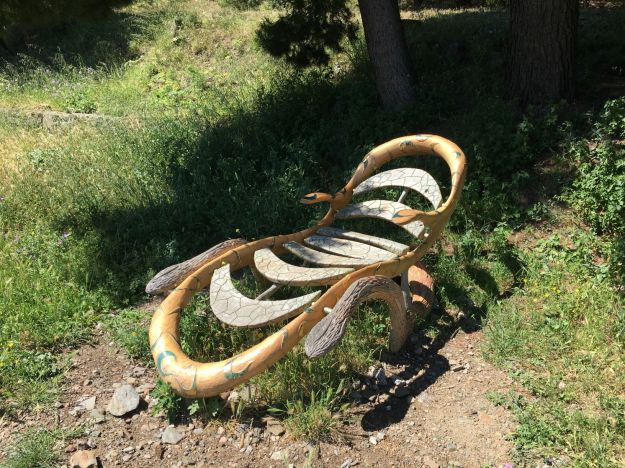
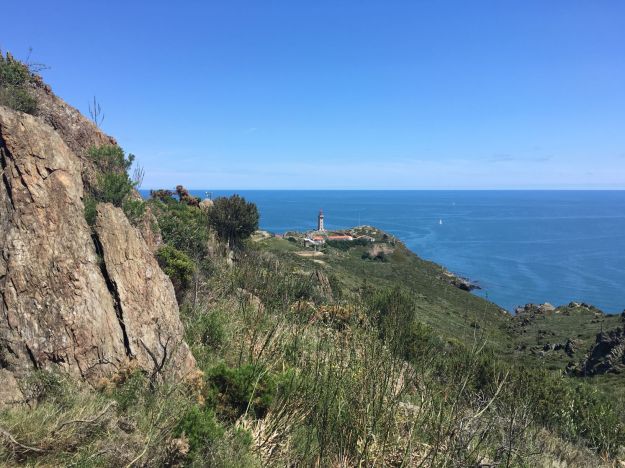
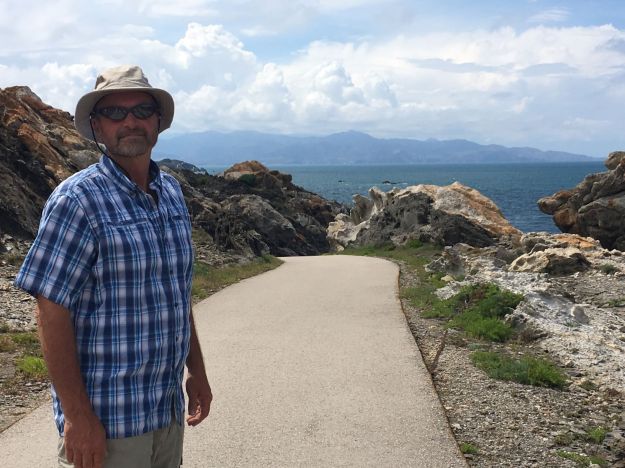
For the next few days we hopped along the French coast.  The first night we visited our Canadian friends Doug and Sandy (and their beautiful Privilege yacht Sah Sen) at Canet en Roussillon, then continuing west we anchored in Anse de Paulilles between the towns of Port Vendres and Banyuls. We soon noticed swells coming in on our side to the point it was so uncomfortable we pulled anchor and relocated to a more sheltered part of the bay – much better!  The next day we hiked to Port Vendres on a scenic cliffside trail with beautiful wildflowers.  After a swim we dinghied into Banyuls for groceries and got back to Wally Walou just as it started to rain – perfect timing!

Anse de Paulilles.small

Port Vendres Hike.small

Port Vendres.small

Dave in Port Vendres.small

Cool chair.small

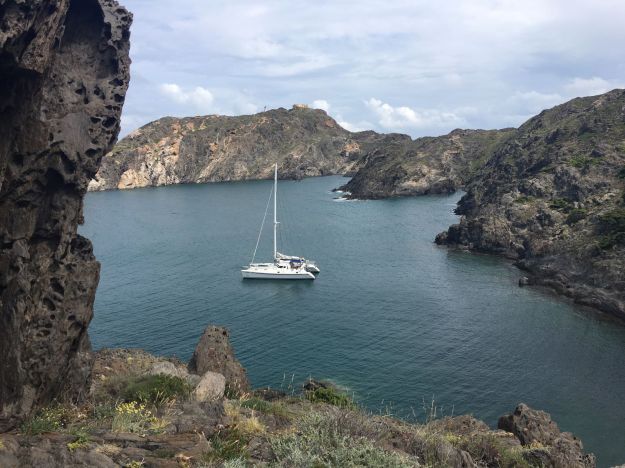
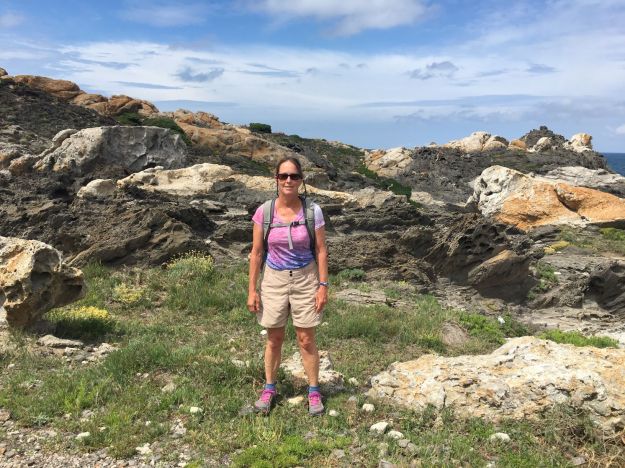
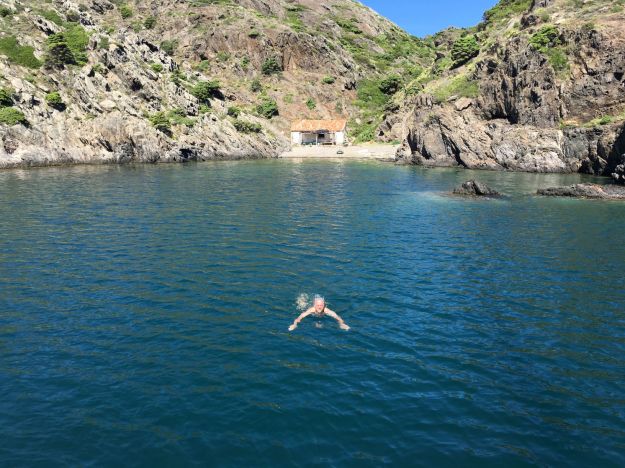
On June 7 we entered Spain.  We pulled into Cala Culip, a small rocky cove recommended by Sandy and Doug for being a “geologists’ Disney Land”.  And yes it was!  We hiked among pegmatites – granite-like rock with large crystals that sometimes include diamonds – and incredibly folded silty shales.  Late that evening there was a loud gathering at what Google Maps identified as a “Super Public Bath”, a small stone building on the beach. We never figured out what a super public bath is, but it sure sounded like folks were having a lot of fun!

Cala Culip.small

Sally_rocks.small

SuperPublicBath.small

Lighthouse.small

Dave_rocks.small

The next morning we got our SUPs out and paddled around for a while then sailed south around Cabo Creus, a point that is notorious for strong currents and winds – but luckily for us the weather was relatively calm.  We anchored at Port Lligat, the home of Salvador Dali, but reservations were needed to get in to tour the home; not the last time we found out that reservations are required for major tourist sites in summer.

PortLligat.smallThe next day we dinghied to shore and walked to the neighboring town of Cadaques for dinner and attempted to find a Spanish SIM card for our phone but no luck.  We were told we could find one in Puerta de Roses just down the coast, so we set off around the corner and anchored off Roses.  After 2 nights there we headed SW and ran into 30 knots of wind and big seas so we detoured to a relatively sheltered cove, Cala de se Riera, which turned out to be a nude beach!  There we did a “mise a la cape”, French for heave to, which we had learned to do from our Outremer trainer Julien – yes catamarans like ours can heave to!  (For the non-sailors, that is a storm tactic that involves orienting the sails and rudders so the boat essentially stops moving forward.)  We relaxed awhile and after a few hours decided to continue on around the corner to the town of Palamos.  As we left the cove we had 25 knots of wind on our nose but the forecast called for it to be calming and turning to be on our stern over the next few hours; but what actually happened is it changed from 25 on our nose, to less than 5, then 25 on our stern, all in about 10 minutes!   It was shocking how quickly it changed, but we made it to Palamos and anchored at a sheltered location behind the harbor breakwater.

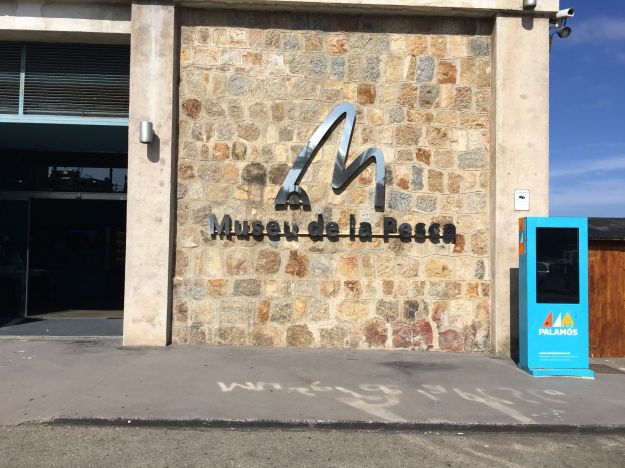
In the morning we explored Palomas which is famous for its gambas, or prawns.  We had dinner at a restaurant recommended by our sailmaker Alain, who lived in Spain in his youth – yum!  That evening a steel sailboat anchored right next to us and we nervously watched it as the wind picked up.  It finally moved farther away before nightfall. The next morning included an interesting visit to a Fishing Museum.

Fishing Museum.small

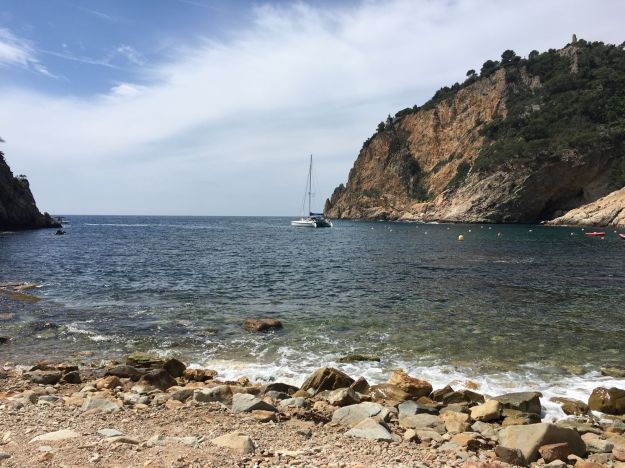
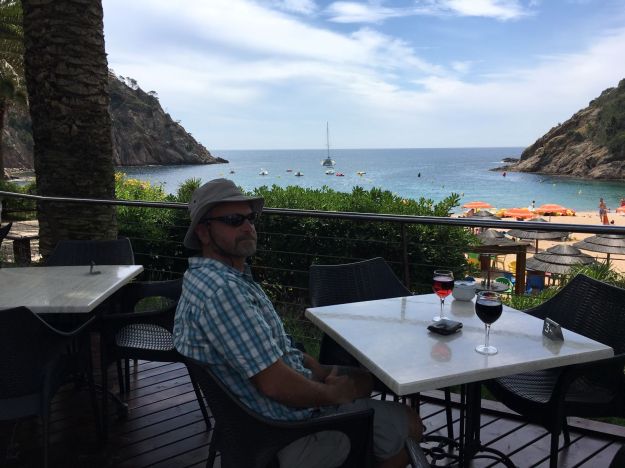
After a very Spanish lunch of tapas and Sangria we observed numerous boats anchoring next to us in the bay.  Time to move on!  We looked at the cruising guide and targeted a protected cove, Tossa de Mar.  But when we got there it was jam packed with boats, so we backtracked and anchored in a nice rocky cove, Cala Giverola.  Lots of motion with waves bouncing off the cliffs but tolerable.  The next morning we went ashore and discovered most of the cove is owned by a resort.  But we walked around and ate at their restaurant, and snorkeled – a nice spot.

Cala Giverola.small

Dave Cala Giverola.small

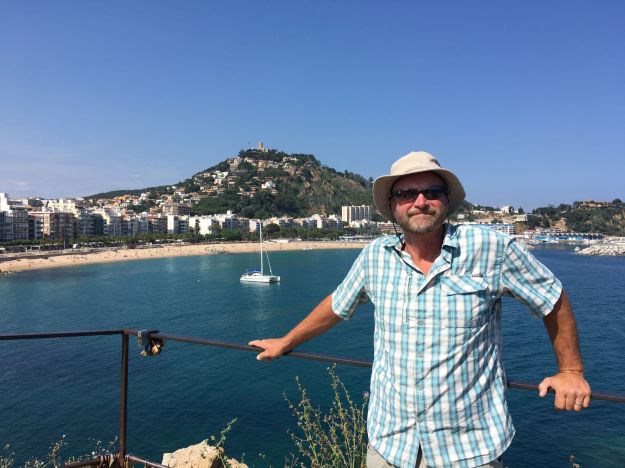
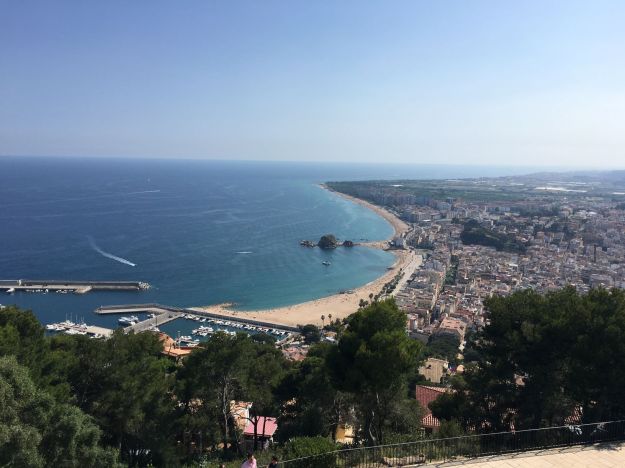
The next morning we SUPed then had a nice light wind sail south to Blanes, where we anchored just west of the harbor.  Later we hiked up a rock called La Palomera, then up a big hill to Castillo de San Juan – awesome views!

Dave Blanes.small

Blanes from Castillo de San Juan.small

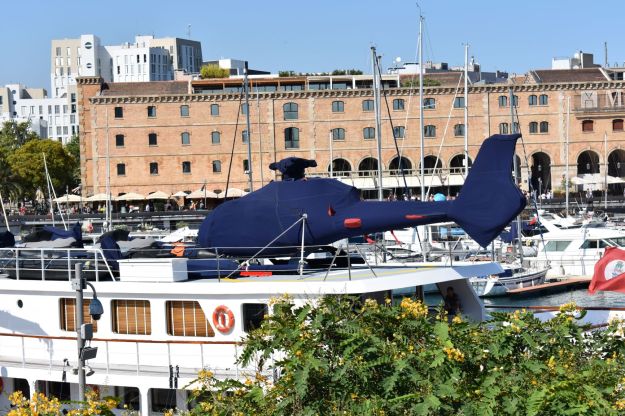
On June 18 we had a nice 8-hour sail to Barcelona.  We had reservations at Real Club Nautico, a yacht club in Port Vells.  According to the guide books it is a private marina but we learned they would take nonmembers if they had room, so we contacted them and were able to get a slip.  We weren’t sure exactly where it was and after going down a couple wrong routes and calling unsuccessfully on the radio we found it on Google Maps.  There was a pedestrian swing bridge we had to go through and it wasn’t clear when it opened or who to contact to get it open.  We waited and finally the bridge opened and we were in!  A great location just at the bottom of La Rambla, the famous tourist street.

As this was our first time stopping at a Spanish harbor (so far we had anchored out every night) we were required to check in to the country.  Fortunately the Spanish government makes it much easier on cruisers than the Italian government does (see our Italy blog).  In Spain, the first time you stay in a harbor the harbor administrators take care of all the paperwork needed to check into the country.  No need to make separate trips to the Coast Guard to check in and check out.  Thank you Spain!

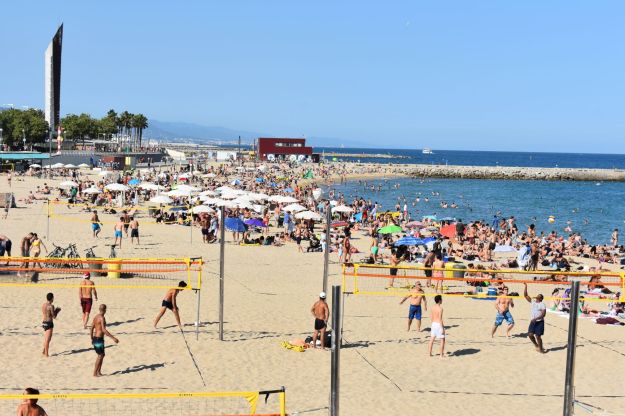
We planned on 3 days in Barcelona but ended up staying 5, waiting for favorable weather to head south to the Balearic Islands.  But the stay was worth it – we both decided Barcelona is our favorite European city so far.  Fascinating architecture, easy to get around, and they have worked hard to convert the old industrial section to an attractive waterfront with beautiful beaches. Many of the parking lots have been moved underground and the land above them converted to parks and trails.  Well worth a visit!

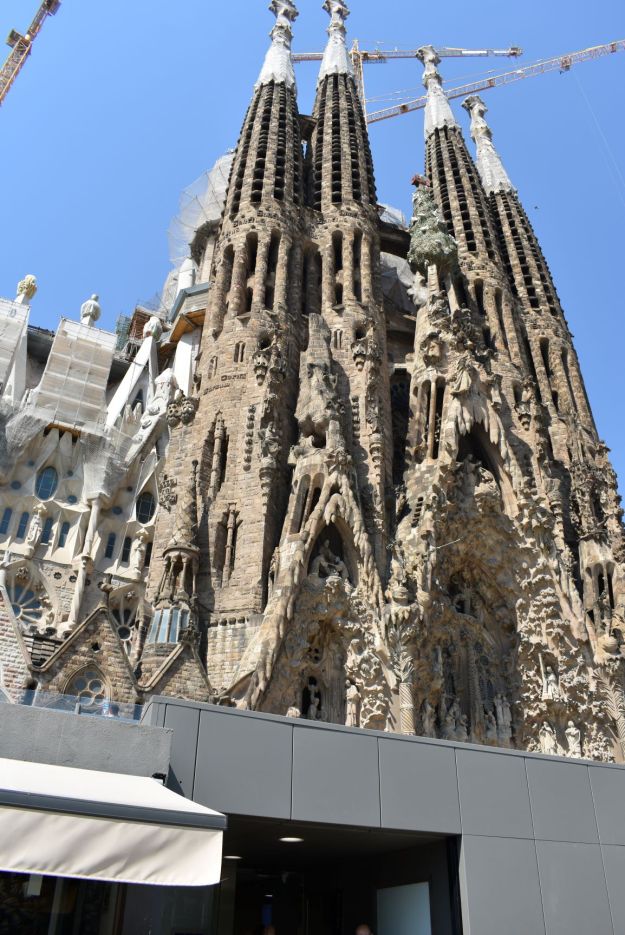
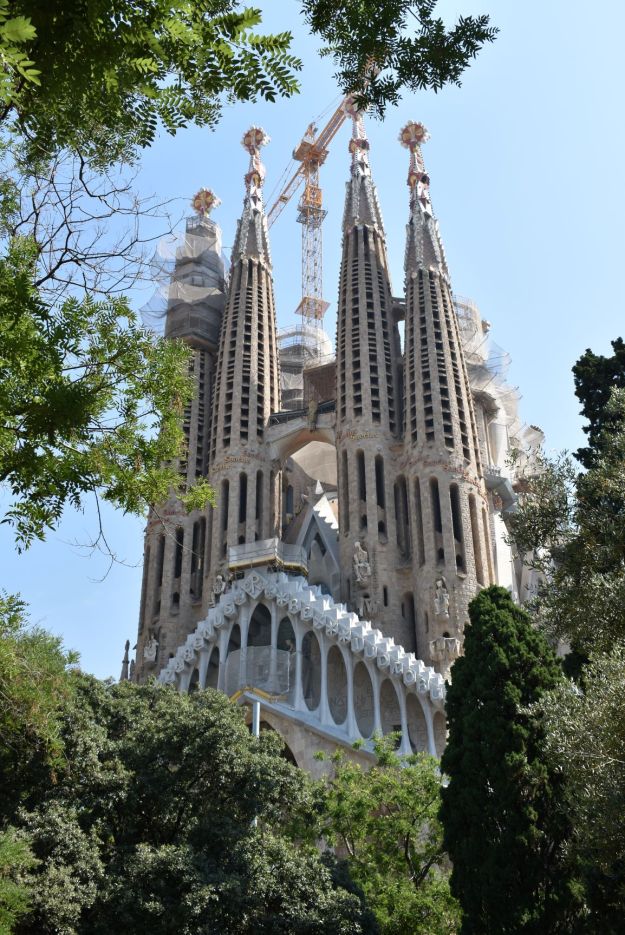
Our first morning we took a city bus tour for a reconnaissance of the city then walked along their 5 kilometers of beaches.  In the next few days we saw a traditional flamenco dancing show and explored the city by foot and by bike; the city has good bike lanes on the major streets. We visited the famous church La Sagrada Familia, designed by architect Antoni Gaudi, which has been under construction since 1892 and won’t be completed until 2030.  Again we found we couldn’t get in without reservations. We also visited Parc de Guell which includes another amazing Gaudi building, but we also couldn’t get in.  Next time we visit we’ll make reservations first!

Parc de Guell.small

La Sagrada Familia2.small

La Sagrada Familia1.small

Helicopter cover.small

Volleyball.small

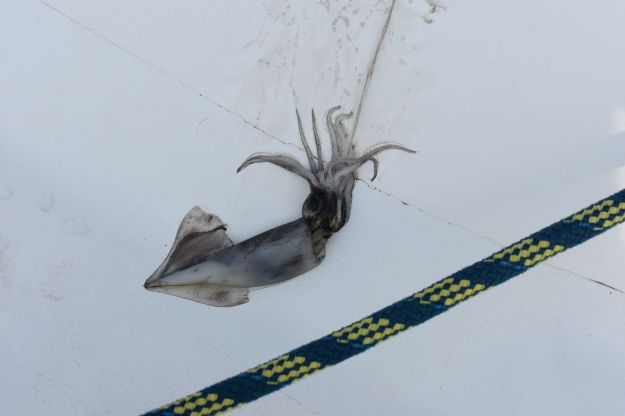
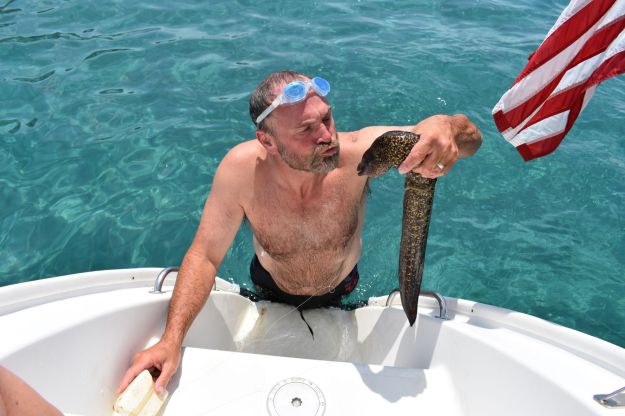
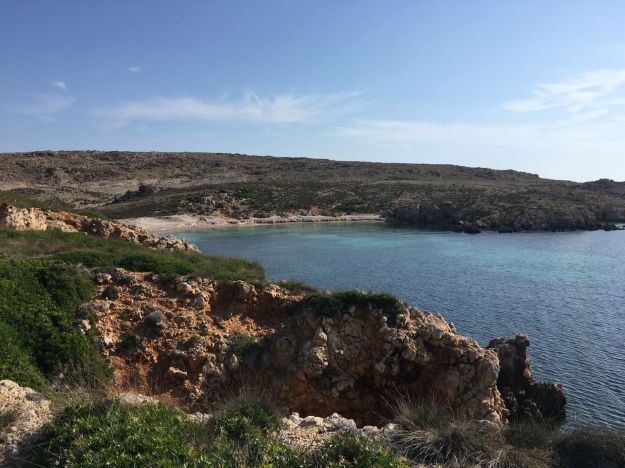
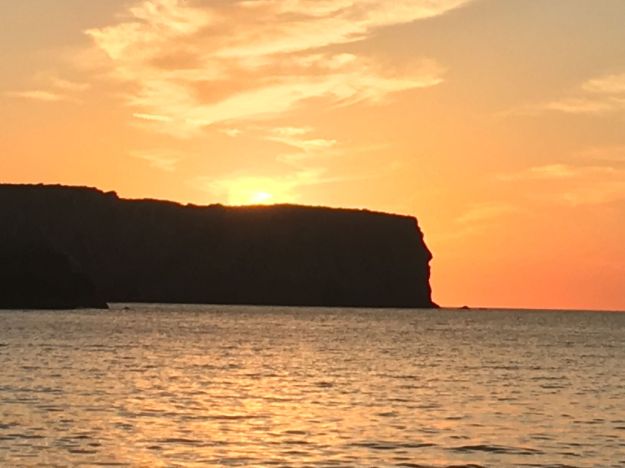
In the afternoon of June 23 we left Barcelona and headed south to Menorca, the northernmost of the Balearic Islands owned by Spain.  We planned an afternoon departure so we would arrive in Menorca the next day during daylight.  It was an uneventful 18 hour crossing, with dolphins on our bows, and when we came on deck the next morning there was a squid on the foredeck!  Not sure if it jumped there or a bird dropped it?  Upon arrival at Menorca we anchored in Cala de Algayerens, a beautiful cove.  Dave swam down to check the anchor (something we have learned to love being able to do) and came back with an eel at the end of a fishing line!  We briefly considered cooking it for dinner but the stench indicated it had been dead for a while, so we released it back to its watery grave.  After a more palatable dinner we watched the sun set behind a cliff shaped like a silhouette of a face.

Squid.small

Eel.small

Cala de Algayerens.small

FaceSunset.small

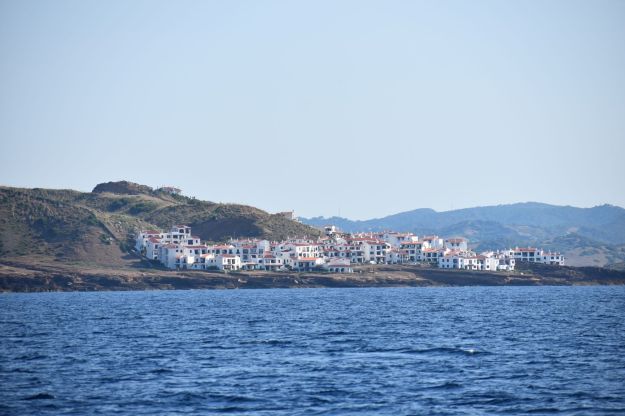
Over the next few days we explored the northern coast of Menorca with lots of snorkeling and SUPing.  It is a dry and relatively undeveloped island compared to the rest of the Balearics.  We visited Cala Fontanellas and Cala Fornells, which is famous for their lobster.  We sampled their lobster stew for dinner; expensive but delicious!  We then sailed around the corner to Cala d’en Tosqueta, a small bay with lots of boats including one that anchored right next to us.  By evening most boats had left except our too-close neighbor so we tried to reposition to a more protected area behind an island but after a few attempts and not getting the anchor to hold, we went back to our previous location.  Turns out our boat neighbor was a diver who goes down to 300 feet to film wrecks.  His son was also with him and went spear fishing in the cove while we were there.  Just one example of interesting people we have met in our travels.

Sailing in Cala Fornells

Near Cala Fornells.small

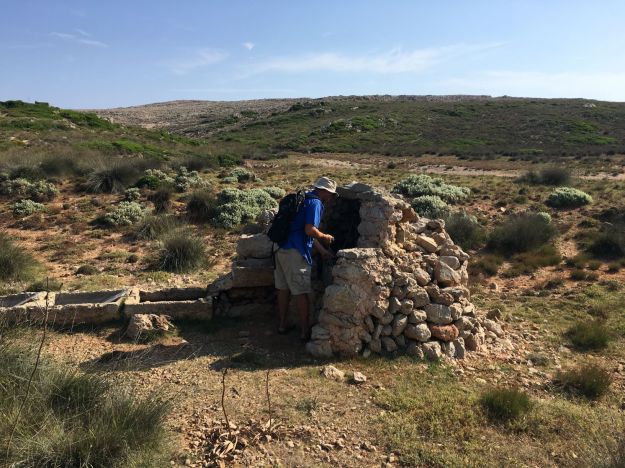
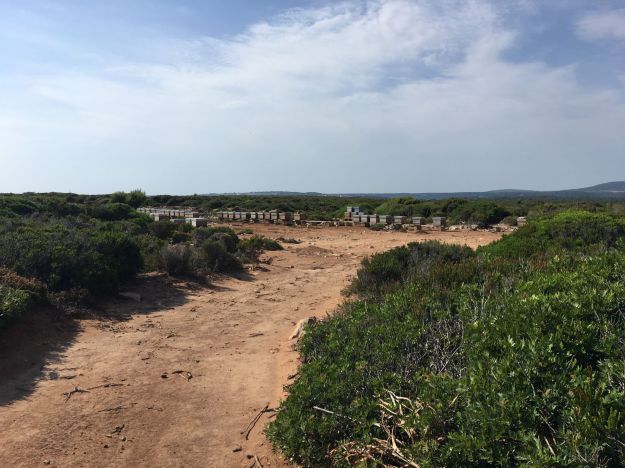
The next morning we went to shore and hiked for a few hours on a gravel track.  We came upon black goats, bee boxes, and an old water well with the traditional bucket lowered down on a rope.  When we got back to the boat Dave swam and checked on the anchor and discovered it was laying sideways on top of flat rock – good thing we were in a relatively sheltered location and the winds were light! (and that we have 30 meters of anchor chain to weigh us down). That afternoon we sailed to Arenal d’en Castell, a circular bay that looks idyllic on the charts; however it turned out to be a very busy place with loud music and a dance party on the beach until late at night.  Slept with ear plugs!

Water well.small

Bees.small

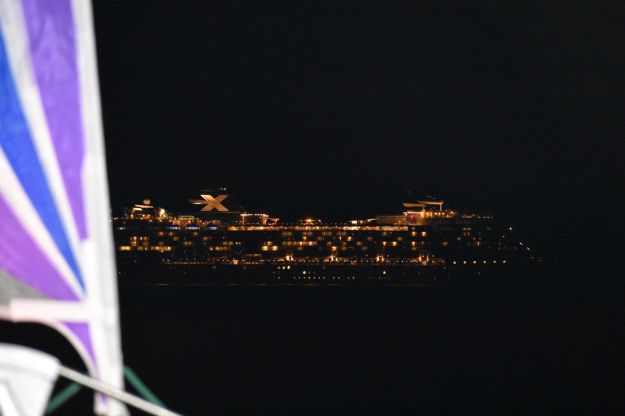
The next morning, July 29, we left Menorca at 9 am and crossed 29 hours north to our home port of Port Camargue, France, our longest crossing yet.  We saw numerous dolphins playing under our bows and came close enough to 2 large ships during the night that we decided to change our course to avoid collision.  Even though as a vessel under sail we had the right of way, colliding with another ship that may not be paying attention is not a desired outcome.

CruiseShip.small

We arrived at Port Camargue at 4 pm on the 30th, glad to be “home” in France!

There and Back Again

October 1, 2017 – after a month of boat projects in Port Camargue, France, we set off east with our friend Bettyjane to explore the Mediterranean coast of France, and then on to Corsica, Sardinia, and Italy.
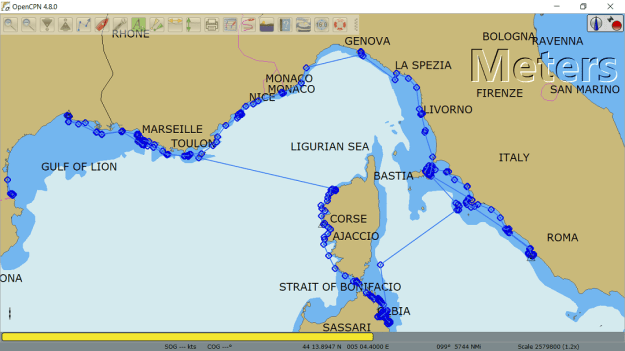
Rome trip chart

We worked our way along the French coast as far east as the Porquerolles, a set of islands near the city of Toulon.  Here and at several other anchorages Dave enjoyed snorkeling to check the anchor – something we can’t do in Alaska!

On October 5 we got up at 2 am and made a 16 hour crossing to the island of Corsica, a region of France.  With a full moon and clear skies, visibility was good.  The amazing amount of ship traffic visible on the AIS system kept us alert all night.
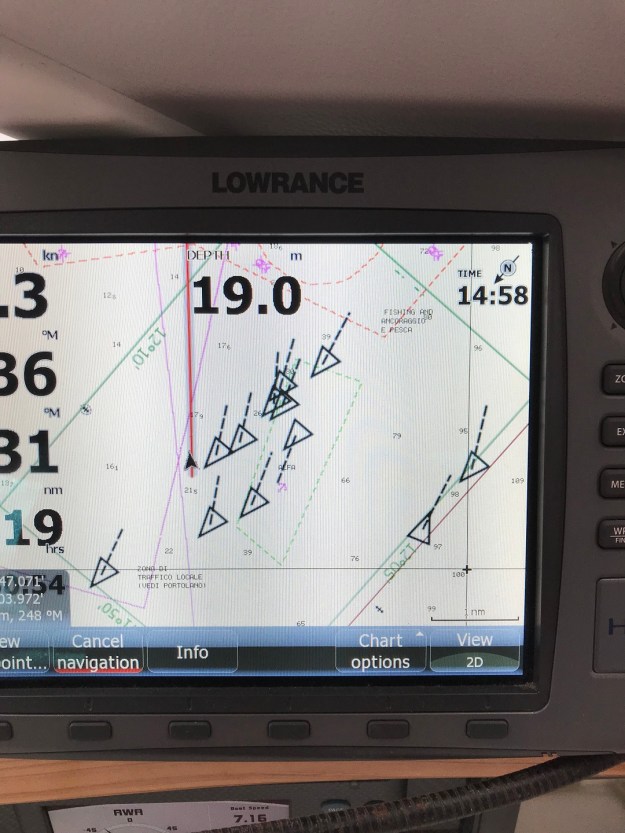
Crowded.small

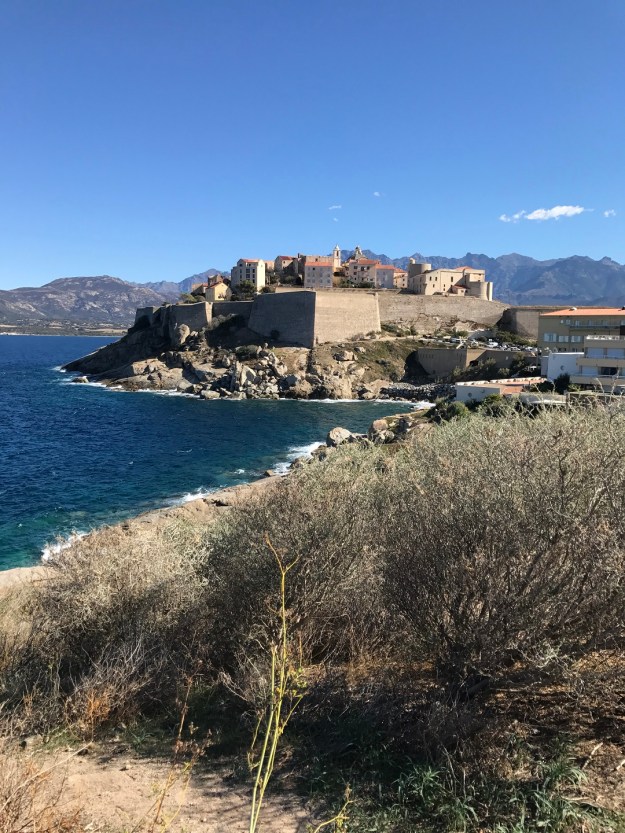
We landed at the town of Calvi, on the NW coast of Corsica, in 30 knots of wind.
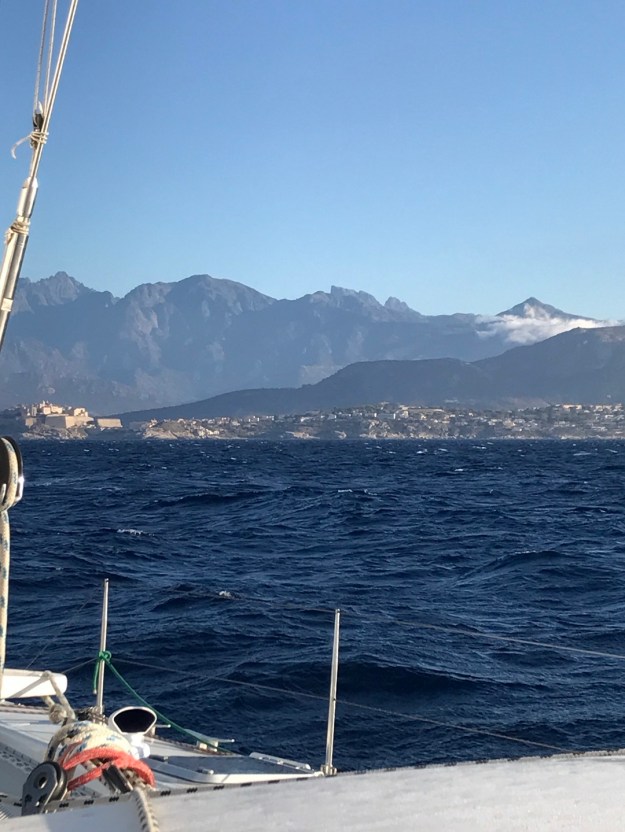
Crossing.small

Calvi.small

This was one of many times the wind picked up just as we were ready to take the sails down! We stayed at Calvi for 4 days, enjoying swimming at the beach, hiking to the citadel, and eating out.  While we were there we were visited by customs officials who reviewed our papers and confirmed that our boat is VAT-paid so we do not have to exit the EU to reset the temporary importation tax clock.  Good news!

On October 9 we headed south along the western coast of Corsica.  We anchored out in the Golfe de Peru about half way down the coast, then spent the next night in the harbor at Bonifacio on the southern tip of the island.
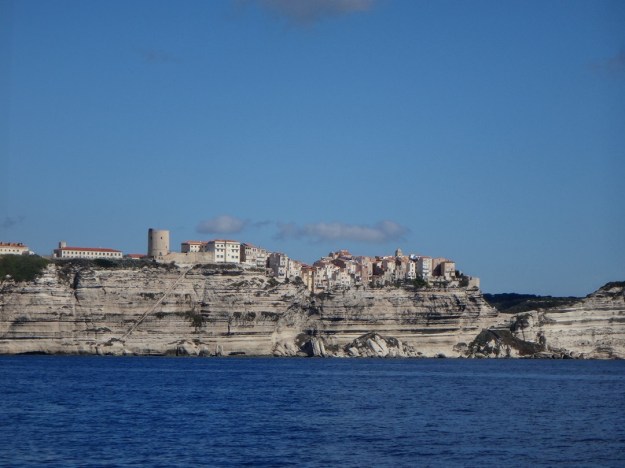
Bonifacio.small

On the way there our port engine quit.  Dave determined there was a clog in the fuel intake line, and after blowing it out the engine started up again.  This was not the last time we would be glad to have two engines!

Our next hop was south to Sardinia, an island region of Italy.  This was the first time taking Wally Walou out of France and we had been informed that we were required to check out of France at a customs office; however, contrary to information in our guide book, there is no customs office in Bonifacio.  After some more research we determined there is no requirement to check out after all, so we headed south and east into Italian waters, destination Porto Cervo, on the NE end of Sardinia. This short passage was full of beautiful granite islands.

Checking in to Italy was more involved than we anticipated.  We arrived in Porto Cervo at 4:00 pm and tied up near the Coast Guard office (in Italy the Coast Guard also assumes customs duties), but it was closed.  Dave took the dinghy to the harbor office, which was also closed.  He waited there until the harbormaster appeared and said the coast guard office would open at 10 am tomorrow.  So we paid for a night and stayed put admiring the beautiful villas above the harbor.  Porto Cervo is a high end destination frequented by movie stars and the rich and famous, with giant yachts in the summer.

The next morning at 10 am the coast guard office was indeed open and after copying what papers they required, they informed us that we needed to purchase a stamp at a shop 6 kilometers away, bring it back to the Coast Guard, and then they would issue the papers we would need for our boat to be in Italy.  So, we put together our folding bikes and rode the 6 km to buy the stamp. The ride was ALL uphill mostly with little or no shoulder and cars that have no concept of what Americans think of as “enough room”!
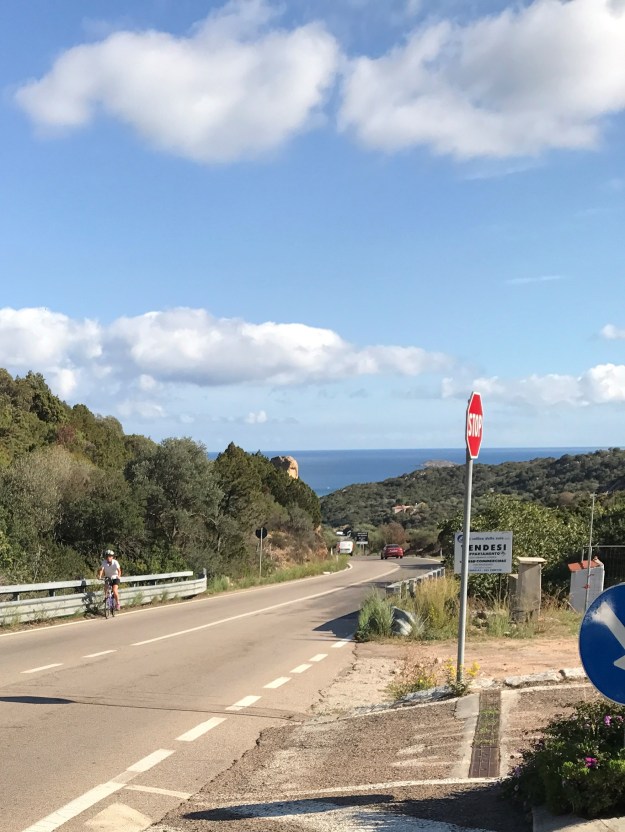
Bike to Stamp .small

Back at the Coast Guard we made it just before lunch and Dave presented the stamp, the officer said his boss would need to review our papers but he wasn’t there, and they were closing the office for lunch, so please to come back about 4 pm….;-)  At this point we were pretty certain we were not going to make our planned sail around the corner to the city of Olbia, where Bettyjane had a flight out the next day.  At 4:00 Dave went back to the Coast Guard and they confirmed all was in order and issued us a “Constituto”, basically a cruising permit that we were required to turn in to the Coast Guard at the last port before we exit Italy.

The next morning we waved goodbye to Bettyjane as she got in a taxi to Olbia to catch her flight, then moved the boat south around the corner to Golfo Pevero.  On the way we passed numerous beautiful granite islands with high cliffs, and watched dolphins jumping in the distance.

GraniteNearOlbia.small

We anchored for 2 nights in Golfo Pevero which we dubbed the “Dog Beach” due to lots of locals walking dogs there.  Dave wanted to change the pitch on the props so he created an extension for his snorkel by attaching a hose to it, and with Sally holding the hose out of the water and handing him tools from the dinghy, we managed to re-pitch both props.  This gave us an extra knot of boat speed on one engine and almost 2 knots with both!  During this exercise we saw a partially submerged float part of a summer mooring ball near our boat so we tied a plastic bottle stuffed with orange rags to it to warn other boaters of the hazard.
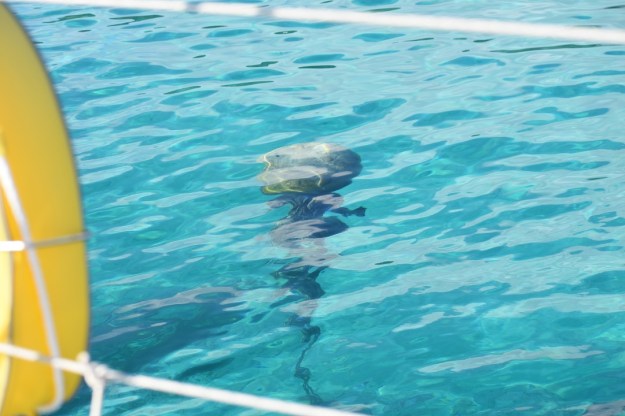
SubmergedMooring.small

On October 15 we moved south and anchored in a bay called Liscia delle Saline, just outside Olbia.  We started in the dinghy on a 4 mile trip into Olbia for groceries but in about a half mile the motor started making odd noises and we were not able to accelerate over a certain point so we shut it off and rowed back to Wally Walou.  After taking the motor off Dave determined we needed a new prop; fortunately there is a Yamaha dealer in Olbia.  We moved Wally Walou into the harbor in Olbia and got a slip for 2 nights, took a taxi to Yamaha and ordered a new prop which would arrive in a week.  So, after provisioning and other chores were complete, we moved south and anchored 3 nights in Cala Coda Cavallo (horse’s tail cove), a nice bay in a marine reserve.
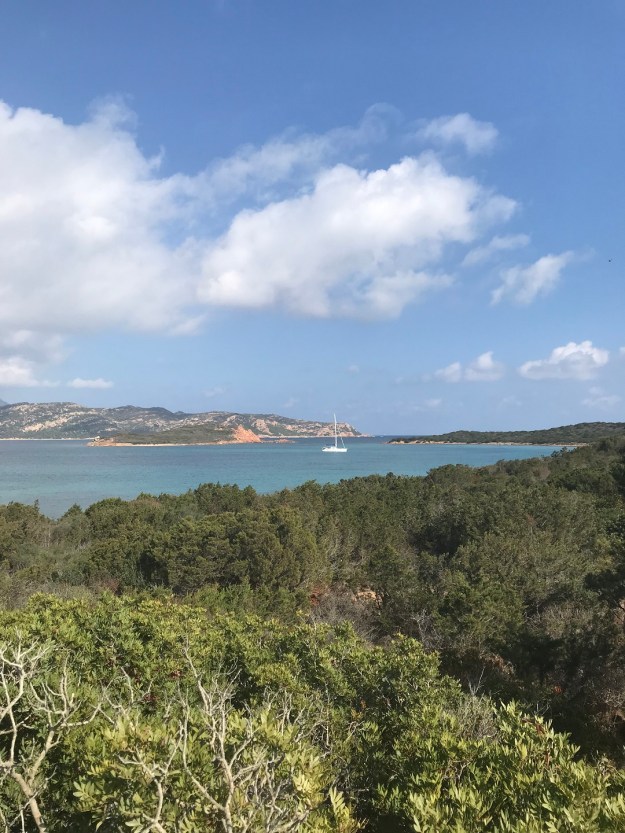
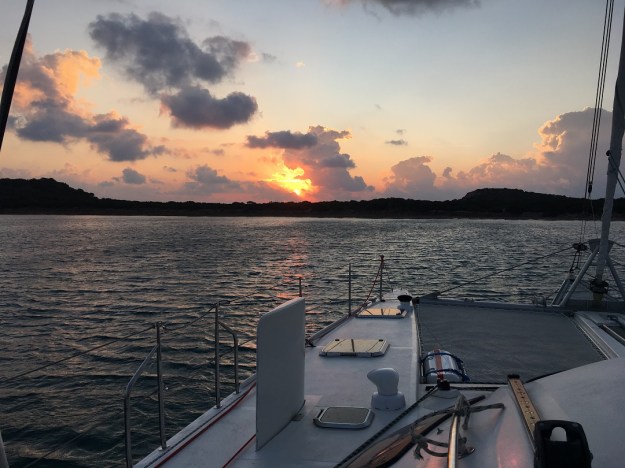
CalaCodaCavalloAnchorage.small

SunsetCalaCodaCavallo.small

Here we hiked, snorkeled and played on our Stand Up Paddleboards (SUPs).  On the 21st we moved SE around the corner to Porto Brandinghy for shelter from the forecasted high winds over the next 2 days.  At 4 am we got up and watched the Orionid meteor shower!  The next day the winds arrived, and with minimal sleep we made it through a day and night of winds consistently in the 40s and gusts over 50 knots.  This was our first time anchoring out in such high winds and our anchor held beautifully.  The next day Dave swam and took pictures of the anchor with a GoPro and found it was thoroughly buried and barely moved!  We were thankful for good anchoring gear, a sandy bottom with good holding, and nothing leeward of us but open ocean.

After picking up our new dinghy prop we crossed over to Italy, our second night crossing and the first one with just the two of us.  Again the ship traffic was amazingly heavy including one unlighted boat we only saw on radar (no AIS signal), and another lighted boat that didn’t see us until the last minute, then scurried out of our way.  We had intended to stop at Giglio Island off the west coast of Italy but the anchorages were too small, rocky, and dangerous so we decide to continue on.  This is where the cruise ship Concordia crashed on the rocks several years ago, and the massive structure built to right the ship is still in place.  We eventually made it to Isola d’Elba (Elba Island), where Napoleon was exiled.  The crossing lasted 24 hours, ending with dolphins playing under our port bow.  Toward the end of this crossing Dave blew out another clog in the port engine fuel intake line.  He later discovered the problem was pieces of sealant around the access port had crumbled and fallen into the tank.  We anchored for 3 nights at Barbarossa Beach, snorkeling over huge clams about 1 foot in diameter, exploring nearby Porto Azzurro, and hiking on a scenic cliff-side trail.
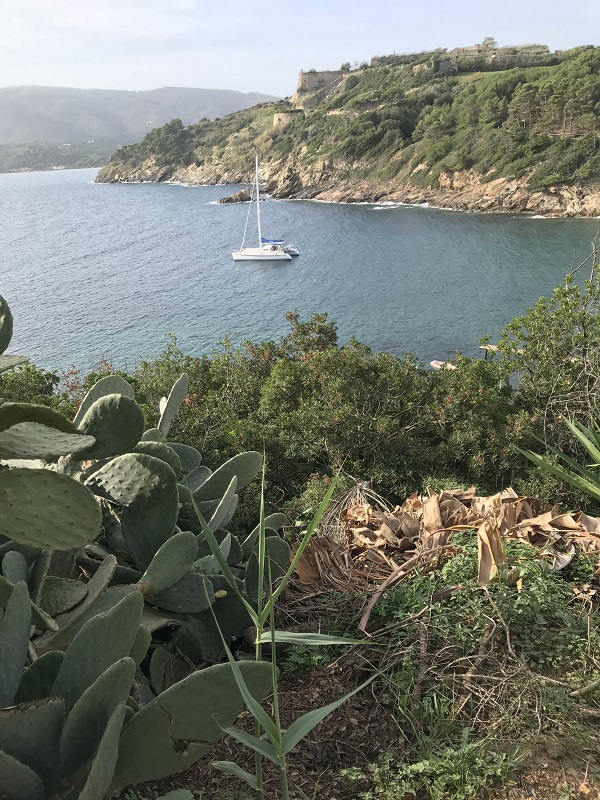
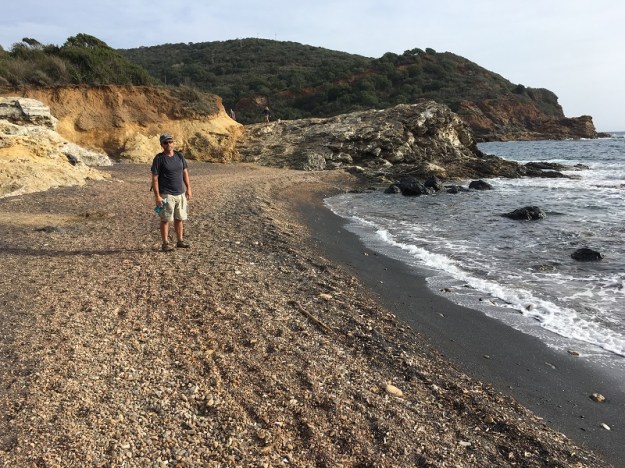
Elba Island Anchorage.small

Hike on Elba Island.small

Next we moved to the north side of Elba Island to a cove called Cala Concia across from Portoferraio, the capital of Elba.  We stayed there 3 nights and SUPed, dodged ferry traffic, and explored the historical sites of Portoferraio.

On November 2 we crossed over to mainland Italy where we anchored for 2 nights at Cala Barbiere.  As with most of the places we anchored we were the only boat there, a nice surprise considering how crowded these areas are in the summer.  From here we worked our way south along the Italian coast.  Temperatures were cooling off so at times we wore our full storm gear.  We came to the conclusion that the reason most people don’t cruise the Med in the winter is 1) most sailboats don’t have heaters, and 2) many shops are closed for the season so it’s hard to find food and supplies. Also the prevailing southeast winds this time of year make for swells that can be very uncomfortable depending on the anchorage.

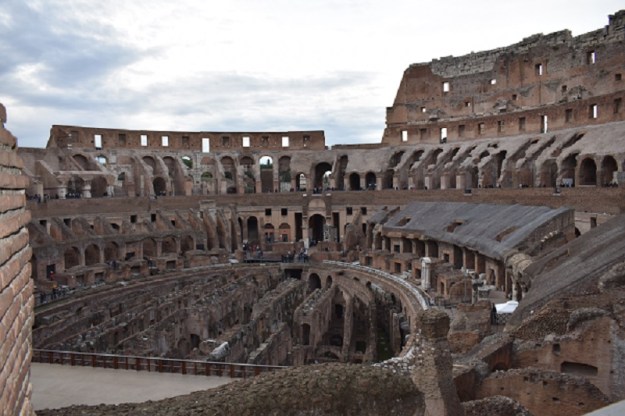
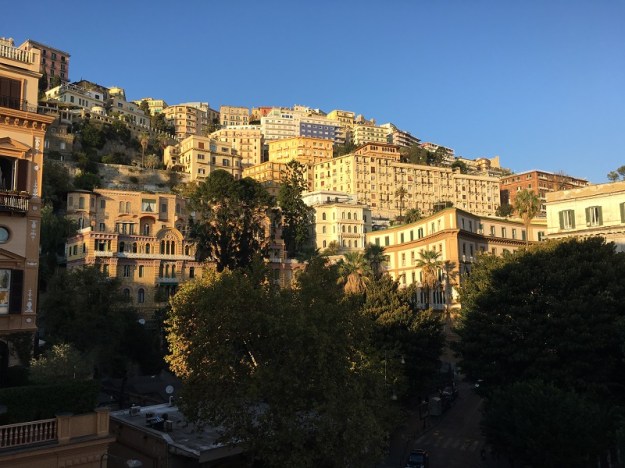
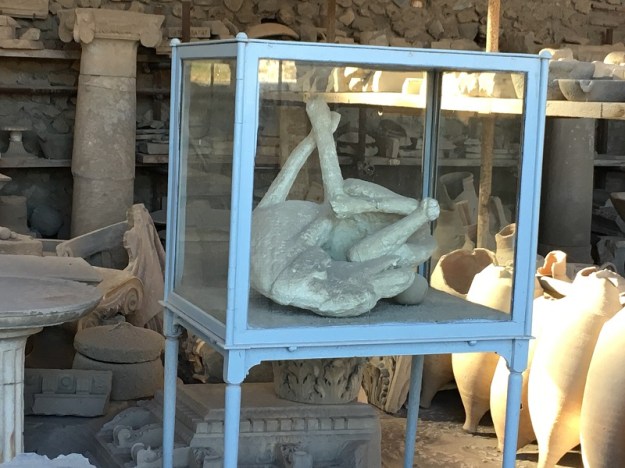
November 10 – 28 we were tied up in Porto Turistico di Roma, a harbor just outside of the Rome airport.  Our friends Janet and Wally joined us and we took trains and explored Rome, Naples and Pompeii.
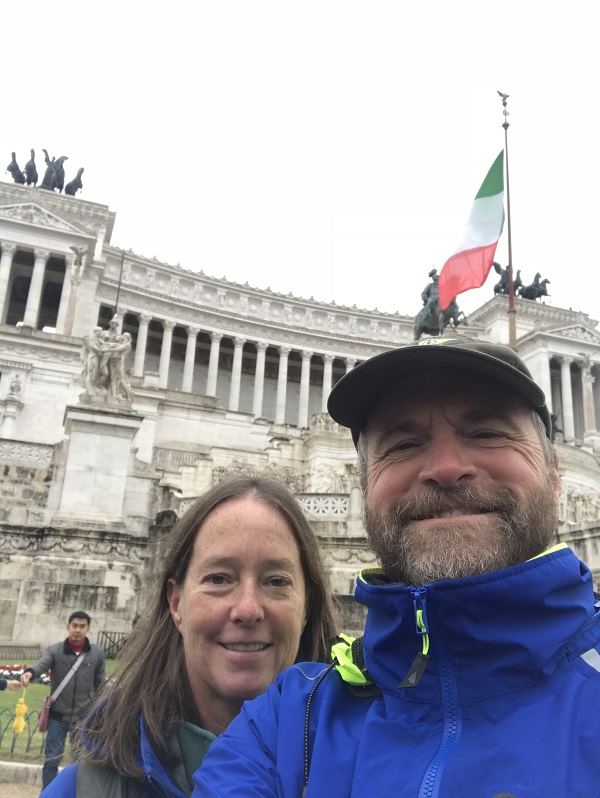
Tomb of the Unknown Soldiers Rome.small

Colosseum.small

Naples.small

Cast2.small

Cast1.small

The 4 of us celebrated Dave’s birthday with a day sail and dolphins playing under our bows – birthday dolphins!

On November 28th we began our journey north and west back up the Italian coast and to France.
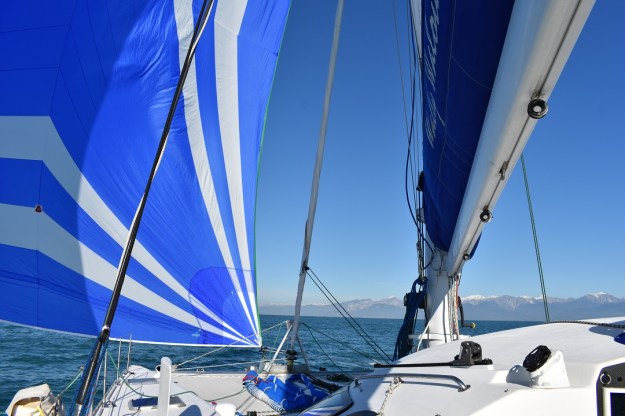
Sailing North.small

Our goal was to arrive back in Port Camargue in mid-December to give us several days before our planned trip back to states for the Christmas holidays.  Instead, because of the numerous storm systems that blow through this time of year, we spent several days at different locations hunkered down waiting for weather to clear.  We anchored out at the picturesque fishing town of Santa Margherita, on the NW coast of Italy, for almost a week.

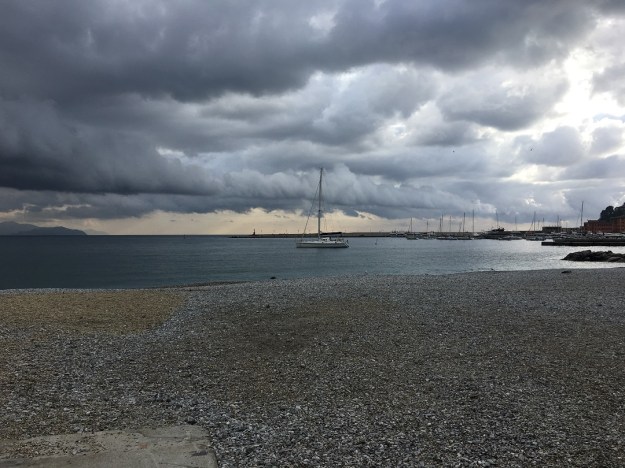
Santa Margherita.small

Santa M Anchorage.small

We planned to stay put there until a storm came through, and thought our location would be protected from the forecasted wind direction.  We were wrong.  We woke up to increasing winds coming directly at us and soon waves were breaking underneath our boat.  As we debated whether to stay or move into the nearby harbor, the rope bridle holding our anchor broke!  That made the decision easy.  Dave worked to keep the boat into the wind while Sally was on the bow bringing up the anchor and getting drenched by waves.  We later discovered that in our haste to get out of there we yanked on the anchor so hard we bent the shank!
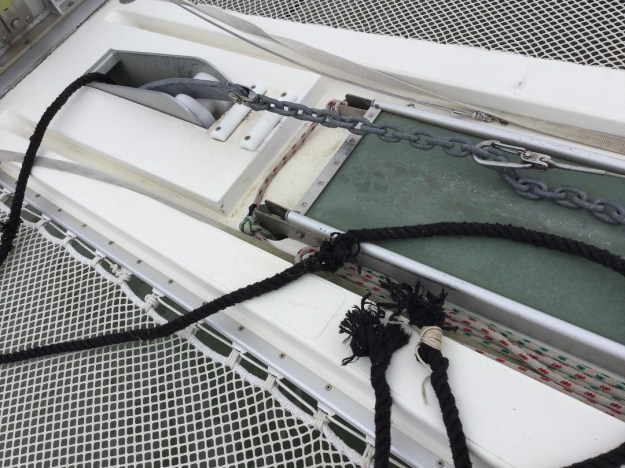
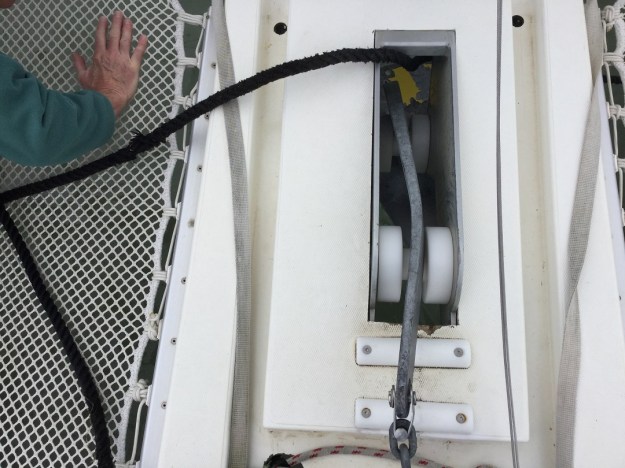
Broken Bridle.small

Bent Shank.small

We pulled in to the nearby harbor and tied up behind the breakwater, glad to be in calmer waters. As we were tying up one of the very helpful dock guys casually mentioned that this bad weather had been forecasted for several days…

The next day after the storm passed we walked back to the beach where we had been anchored and were shocked at the extent of debris that had washed up.  Backhoes were clearing gravel and logs out of the doorsteps of the beach-side buildings.  We felt fortunate that the storm hit in the daylight while we were awake so we were able to react in time, and we did not ourselves become part of the debris on the beach!

The next day we headed west, dodging floating debris from the storm.  As we were sailing along we felt a bump, and soon realized we had hit a large tree limb and its branches were hung up on our port daggerboard.   It wouldn’t come loose on its own so finally we raised the dagger board and put the boat in reverse and it floated away.  No damage!

On December 17 we arrived at San Remo, the last major Italian town before the French border.  After tying up we went to the Coast Guard office to return our cruising permit and check out of Italy.  There we learned we were supposed to have given our permit to the Coast Guard upon arrival at every port we visited in Italy, then go back and retrieve our permit with the Coast Guard’s signature before leaving each port. We apologized and said we didn’t know about that procedure, and fortunately they let us go with no penalty.  In hindsight we were glad we didn’t know about it, as it would have been very cumbersome!

From San Remo we moved west into France and arrived back in Port Camargue on December 21, our first time sailing on winter solstice!  Since October 1st we had covered about 1300 nautical miles.  During this adventure we learned to pay attention to wave height and direction forecasts because the sea state can make for a very uncomfortable ride in the Mediterranean, which has notoriously short, steep, choppy seas.  In spite of the forecasts saying otherwise, during the last couple of days we experienced 3 meter waves with short (few second) periods, and 30 knot winds on our beam.  We did our best to slow the boat down by reefing and altering course direction but even with all 3 reefs we were still moving at 12 knots, which would have been great fun only if the seas were calmer!

All in all our first real cruising experience on Wally Walou was a success and we look forward to our next adventure to Spain this spring!

Southern France

We left Wally Walou in a slip in the harbor of Port Camargue, in southwestern France, for about a year starting October 2016. During that year we flew back and forth from Anchorage several times to work on upgrades, repairs and maintenance, but avoided the busy summer months.  In July and August, when much of Europe is on “holiday”, this area is super crowded.  We heard that boats on the far side of the Port Camargue harbor that are farthest away from the harbor entrance/exit, can spend 45 minutes to an hour just getting out of the harbor because of all the boat traffic!  Lots of people love this Mediterranean climate, as do we!

This area of southern France is a flat coastal plain with lots of sand and pink flamingos.  Pink Flamingos.small

Shopping

It took a while, but we eventually got used to the French businesses and government offices being closed every day between 12:30 and 2:00 for lunch.  Initially we always seemed to decide to go shopping around then, but later learned to schedule around it.  Although we first considered it an annoyance as a consumer, we came to appreciate the concept of people taking the time to disconnect from work and share the great food they have in France.

For the first couple of days in Port Camargue we had a rental car but since then we have been on foot and on our bikes.  The culture here in these coastal towns is very much one of walking and biking.  Many people have baskets on their bikes in which are carried everything from little dogs to baguettes.  We walk or bike to the local grocery stores and bring back our loot in a backpack, a definite change from weekly Costco or Fred Meyers grocery runs at home.  More trips with less stuff each time.  It feels comforting, like how it used to be before big supermarkets.

Transitioning to a Crusing Life

Buying a boat in a foreign country with a different language is challenging.  Most of the paperwork during the buying process was in French, and the operations manuals, documents, labels, etc. on the boat are also mostly in French.  Fortunately many of the people we interact with speak at least some English. Google Translate is also a wonderful tool for communicating with boat work contractors and for shopping!  Dave spent many hours with his iphone and talking to a French worker’s iphone discussing the day’s plans.  Thank you Siri!

When we realized the standard tourist visa for 90 days wasn’t going to work for us, we applied for French long stay visas which will allow us to be in the “Schengen” countries, similar to the European Union, for a year and then the visas can be renewed for another year.  In spite of intimidating instructions on the French Consulate’s website we breezed through the interviews in the San Francisco consulate in January and had our temporary visas in about a week.  After arriving in France we sent a form to the Office of French Immigration and Integration (OFII) and, after receiving a letter back from them, rented a car for a day and drove in to the OFII office in Montpellier for a medical evaluation.  We figured they want to make sure people aren’t coming here just to take advantage of the low cost medical.  We went to a radiology place and had chest Xrays, then walked about 10 minutes to the OFII where we met with a doctor who asked a few questions, took our heights and weights, and had us read a line on a vision chart.  Back to the waiting room for a couple of hours then, just as we thought they were going to come tell us we had to come back after lunch, we were called in and after about 10 minutes we were officially French residents!  We got a residence permit glued to our passports that we can renew in a year.   We also paid French “taxes” of 250 euros each to finalize the visa process.  But it should be worth it, this way we aren’t limited to 90 days in any 180 days which would have been the case on a normal tourist visa.

In February 2017 we winterized our house in Anchorage and our good friends Amy and Cal agreed to take care of it for us.  We had our mail forwarded to them, and headed to France again on February 14, our 2 year wedding anniversary!  It was spent madly packing, preparing the house for being away for 3 ½ months, and taking 4 large boxes to the post office to be shipped to our Outremer contact Pierre (he offered to let us ship things to him, something he would regret later…).  In addition those boxes we had 3 checked bags each on the plane, including Bike Friday folding bikes that come in a Samsonite suitcase – sweet!  We tested them in San Francisco in January and loved them.  Those bikes plus lots of tools and stuff to make living on Wally easier and more comfortable added up to 6 checked bags, which we vowed to never do again.  Amazingly, all 6 of our bags showed up at our destination of Montpellier, the largest city near Wally, but the 4 shipped boxes got stuck in customs.  Thankfully Pierre spent a few hours at the customs office talking them out of charging us several hundred dollars in Value Added Taxes (VAT).  Dinner for Pierre and his family was on us!

The thought of living full time on a boat was a bit scary.  We weren’t sure how would we adjust to a small space relative to our comfortable house in Anchorage.  But after spending a few weeks aboard we realized how little we really need, and that we are happy together wherever we are.  Who needs a house full of stuff anyway?